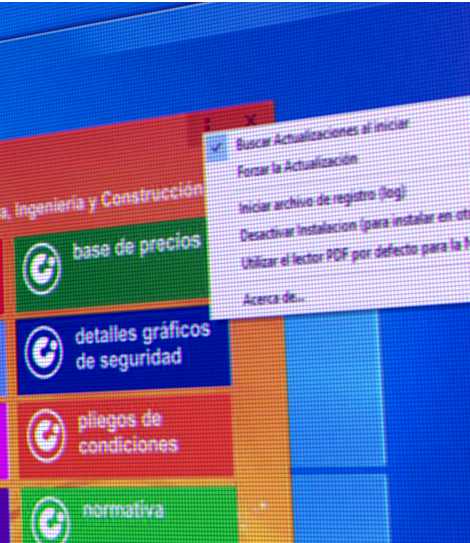
Para instalar la última versión desde cero o para actualizar.
Descargue desde esta página segura el instalador de los programas, tanto si desea reinstalar o actualizar como si las instala en un nuevo ordenador:
Tras la descarga ejecute el instalador, que instalará el integrador de programas. Para más seguridad lo puede ejecutar haciendo clic derecho y "ejecutar como administrador".
Luego se descargarán automáticamente las últimas versiones de los programas Construbit.
Para este servicio es necesario disponer de una suscripción.
Si tiene problemas con la descarga del archivo anterior (en algunos ordenadores no se pueden descargar archivos ejecutables desde Internet) pruebe con la versión comprimida:
Ejecute el instalador tras descomprimir el archivo.
Descarga válida para clientes con suscripción.
En caso de dudas o inconvenientes por favor contacte al servicio técnico que le asistirá para resolverlo. Si instala en un ordenador nuevo le pedirá su número de usuario.
Act V — Politics of Preservation Tupac’s voice—about systemic violence, economic precarity, and racial injustice—becomes instructional if preserved faithfully. Compression is political when it determines who has access: a password-protected RAR, geoblocked releases, or paywalled editions gatekeep cultural inheritance. Conversely, free circulation democratizes legacy but can strip context. The tension is emblematic of Tupac’s own contradictions: he demanded airtime for the voiceless while navigating industry gatekeepers who monetized his life.
"2Pac Greatest Hits Rar" arrives like a zipped archive of grief and defiance—compressed files of a life spent equal parts on the frontline and inside the studio. This chronicle treats that title as more than metadata: "Greatest Hits" evokes canonization; "Rar" signals compression, loss, and the work of preserving what might otherwise fragment. Together they frame Tupac Shakur as both cultural giant and delicate data, archived against erasure. 2pac Greatest Hits Rar
Act IV — Fan Labor and Transmission "RAR" gestures to fan culture: the long tail of mixtapes, bootlegs, and shared drives. Fans act as archivists, curators, and mythmakers—reassembling demos, unreleased verses, and alternate mixes. This labor is both devotional and reconstructive: fans not only preserve Tupac but also remake him. The archive’s instability feeds myth: every re-rip or repackage creates a new Tupac for a new generation. In this sense, "2Pac Greatest Hits Rar" is less a final statement than a relay baton—compressed files passed hand to hand, each transfer shaping memory. Act V — Politics of Preservation Tupac’s voice—about
Act III — The Sound as Text Listen to the compilation as a narrative arc rather than a playlist. Early tracks sound urgent, insurgent, youthful—drums punch with newspaper headlines as cadence. Mid-career numbers broaden scope into introspection and social diagnosis; Tupac becomes both witness and oracle. Posthumous entries introduce spectral production: synthesized choruses, guest features, and studio ghosts. The "RAR" rhythm is therefore temporal: it moves from living, immediate takes to stitched-together memorials. Sonically, compression can squash dynamic range—intensity survives, quiet moments thin—the result is a portrait with some brushstrokes blurred. The tension is emblematic of Tupac’s own contradictions:
Descargue la demo si aún no es cliente y quiere evaluar el producto.